 Quanzhou Ausenist Technology Co., Ltd
 VFD Selection for a Water Pump Project at 3450m Altitude
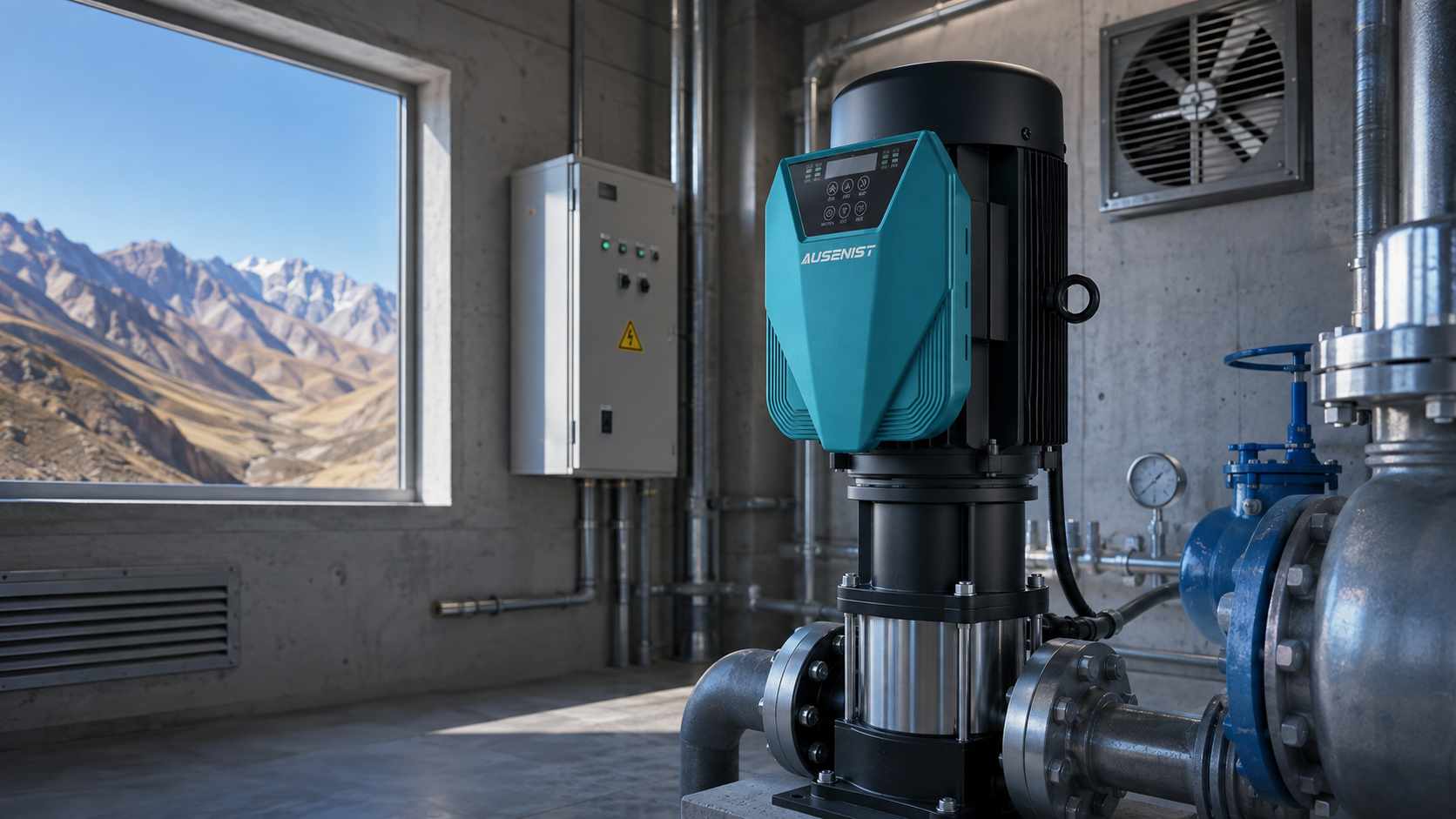
Engineering reference rendering; it is not a customer-site photograph.
At 3450m altitude, a pump VFD cannot be selected from motor kW alone. Lower air density reduces cooling and electrical-clearance performance, so the drive’s usable output current must be reviewed under the manufacturer’s altitude-derating rules. The normal solution is to choose sufficient current margin, improve ventilation and verify temperature under real load.
Reference Design at a Glance
| Item | Reference Requirement |
|---|---|
| Reference market | Bolivia |
| Installation altitude | Approximately 3450m |
| Pump | 11kW centrifugal transfer pump |
| Motor | 380V three-phase induction motor |
| Supply | 380V three-phase |
| Suggested series | AUSENIST YS620 or YS820, selected by derated current |
| Key issue | Reduced cooling capacity at altitude |
What Information Is Required?
- Motor voltage, current, frequency, power, speed and insulation data.
- Exact altitude, minimum and maximum ambient temperature.
- Indoor or outdoor installation and available airflow.
- Enclosure or cabinet type, spacing and heat sources.
- Pump duty point, operating hours and overload expectations.
- Supply quality, generator use and cable length.
Selection Example
For an 11kW, 380V pump at 3450m, first identify the motor rated current. Next, apply the altitude and temperature correction required for the selected AUSENIST configuration. If the corrected continuous current of an 11kW-class drive is below the motor requirement, select the next appropriate current frame rather than forcing the nominal 11kW match.
The exact derating percentage is not stated here because it must come from the confirmed model and installation conditions.
Recommended Configuration
| Item | Engineering Direction |
|---|---|
| VFD current | Greater than motor current after derating |
| Mounting | Vertical, with specified clearances and unobstructed airflow |
| Enclosure | Protect from dust and moisture without trapping heat |
| Switching frequency | Use the approved setting; reduce only if required by thermal review |
| Acceleration | Match supply strength and pump inertia |
| Temperature monitoring | Record VFD and motor temperature during maximum duty |
Why This Configuration?
A larger current margin reduces thermal stress when thin air removes less heat. Good spacing and airflow are equally important: oversizing a drive inside a sealed, overheated cabinet can still create problems. At high altitude, the complete installation—not just the VFD nameplate—determines reliability.
Expected Result and Acceptance Checks
The expected result is stable operation without thermal or overcurrent trips across the required duty range. Acceptance should include maximum-flow current, enclosure temperature, repeated starts, supply-voltage variation and protective-trip verification. Temperature data should be recorded after the system reaches thermal equilibrium.
Common Mistakes
- Ignoring altitude because the motor kW appears to match.
- Applying a generic derating percentage without confirming the exact model.
- Installing the VFD in a small sealed box with no heat calculation.
- Overlooking dust filters that become blocked over time.
- Increasing pump speed to compensate for poor hydraulic design.
AUSENIST Solution
AUSENIST can review altitude, temperature and motor current, then recommend a suitable YS620 or YS820 current frame and installation method. Customized voltage, enclosure and preset parameters can be evaluated for pump OEMs and project contractors. Final approval requires complete environmental and electrical data.
FAQ
Must every VFD be oversized at 3450m?
The required margin depends on the selected model, output current, temperature and cooling method. A formal derating check is necessary.
Does IP54 eliminate the altitude issue?
No. An enclosure protects against dust and water ingress but does not eliminate reduced air-cooling performance.
Should the motor also be checked?
Yes. Motor cooling, insulation and permissible loading may also change at altitude.
Send us the motor nameplate, exact altitude, ambient-temperature range, enclosure plan and pump duty. We can prepare a derated VFD selection for review.