 Quanzhou Ausenist Technology Co., Ltd
 220V Single-Phase Input VFD Solution for a Three-Phase Pump Motor
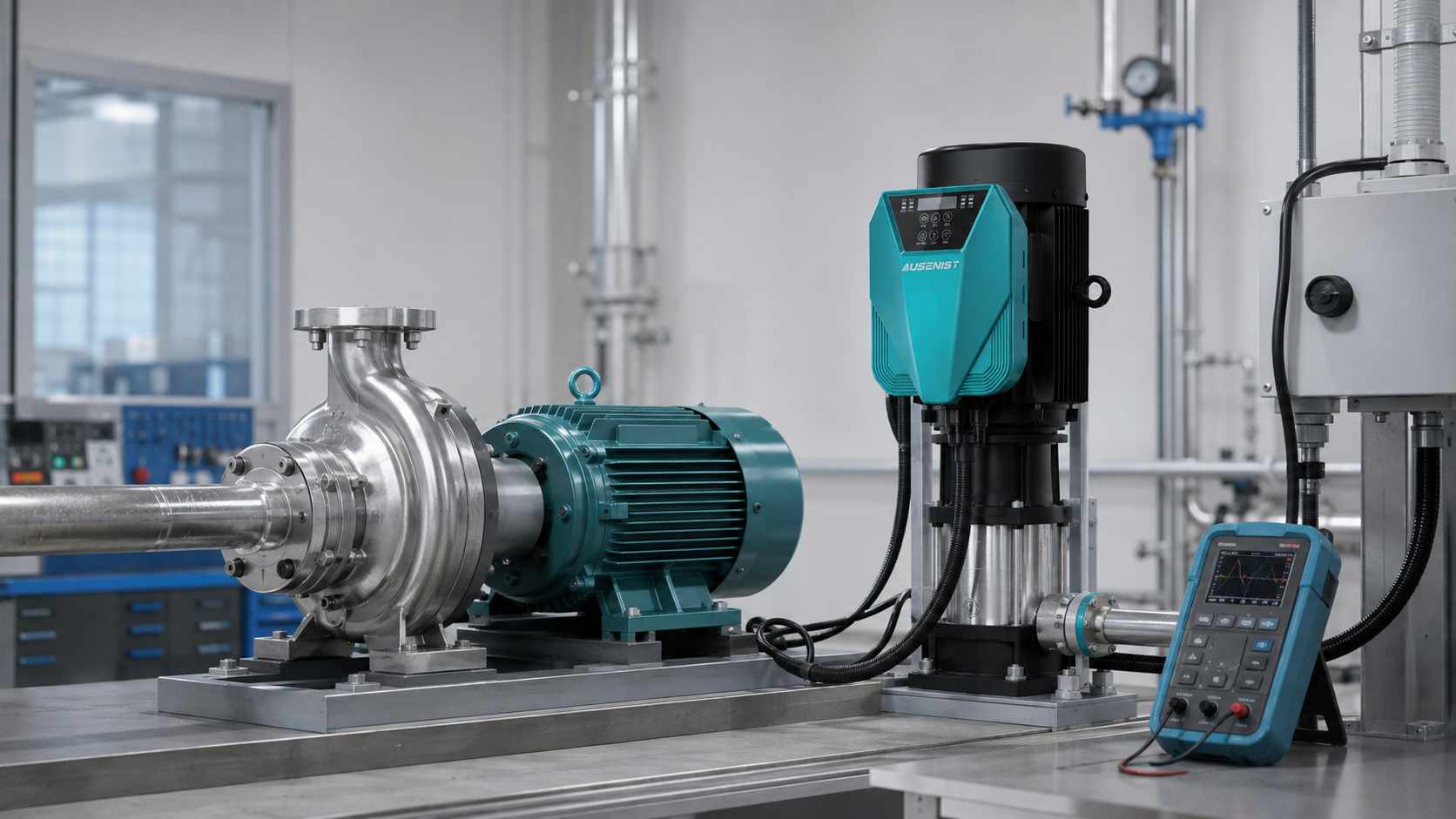
Engineering reference rendering; it is not a production-line or customer-site photograph.
A three-phase pump motor can sometimes be operated where only 220V single-phase power is available, but the correct solution depends on the motor voltage. A standard 220V-class VFD normally provides approximately 220V three-phase output; it does not automatically produce 380V. A 380V motor requires a purpose-built 220V single-phase input to 380V three-phase output configuration and careful input-current sizing.
Reference Design at a Glance
| Item | Reference Requirement |
|---|---|
| Customer type | Water pump manufacturer |
| Available supply | 220V single-phase |
| Pump motor | Three-phase induction motor |
| Preferred motor option | 220V three-phase where the winding permits it |
| Special option | 220V single-phase input to 380V three-phase output |
| Suggested series | AUSENIST custom pump VFD configuration |
What Information Is Required?
- Motor nameplate and a photo of the terminal links.
- Whether the motor is rated 220/380V, 230/400V or 380V only.
- Motor rated current at the intended connection voltage.
- Pump type, starting head, flow range and duty cycle.
- Site breaker capacity, cable size and acceptable input current.
- Required quantity, enclosure, branding and preset parameters.
Selection Example
Consider a 2.2kW pump motor marked 220/380V, delta/star. With a suitable 220V three-phase motor connection, an AUSENIST 220V-class single-phase-input pump VFD may be selected by output current. The input circuit still carries higher current than an equivalent three-phase supply, so the breaker and cable must be reviewed.
If the motor is 380V only, do not use the same configuration. AUSENIST must confirm a boost-output version designed for 220V single-phase input and 380V three-phase output. The drive must be sized for both motor current and single-phase input loading.
Recommended Basic Configuration
| Setting | Initial Direction |
|---|---|
| Motor connection | Follow the motor nameplate and winding diagram |
| Motor voltage/current | Enter the values for the chosen connection |
| Maximum frequency | Match the motor rated frequency unless approved otherwise |
| Acceleration | Lengthen if the input supply is weak or the pump starts under head |
| Current limit | Coordinate with motor data and pump duty |
| Pump control | Constant pressure, fixed speed or external command as required |
Why This Configuration?
Matching the motor winding to a 220V-class output is generally simpler than boosting to 380V. Where redesigning the motor is impossible, a purpose-built boost-output drive can be considered, but it is not a universal substitute for three-phase utility power. Available input capacity may become the limiting factor.
Expected Result and Acceptance Checks
The expected result is normal three-phase motor operation from the specified single-phase source, provided the input circuit and VFD are correctly sized. Factory testing should include full-load current, low-voltage behavior, motor temperature, pressure-control response and repeated start/stop cycles.
Common Mistakes
- Assuming every 220V VFD produces 380V output.
- Connecting a dual-voltage motor in the wrong star/delta arrangement.
- Sizing the single-phase breaker from motor kW alone.
- Using a normal three-phase-input VFD on single-phase power without approval.
- Ignoring pump current under actual head and flow.
AUSENIST Solution
AUSENIST can review the pump motor winding, provide standard 220V-class or special boost-output configurations, preset pump parameters and support OEM branding. Projects with unstable generators, undersized single-phase feeders or unknown motor windings require additional engineering confirmation and may not be suitable.
FAQ
Can a normal 220V VFD run a 380V-only motor?
Normally no. A dedicated voltage-boosting design is required.
Is VFD output single-phase or three-phase?
For this application, the output to the pump motor is three-phase even though the input supply is single-phase.
Can the same solution be used above 4kW?
Possibly, but input current rises quickly. Supply capacity, drive design and thermal margin must be checked for every power level.
Send us your motor nameplate, terminal connection, local supply and annual demand. We can recommend a suitable VFD configuration, parameter settings and OEM solution.