 Quanzhou Ausenist Technology Co., Ltd
 How to Protect a 7.5kW Deep Well Pump VFD with a 180m Motor Cable
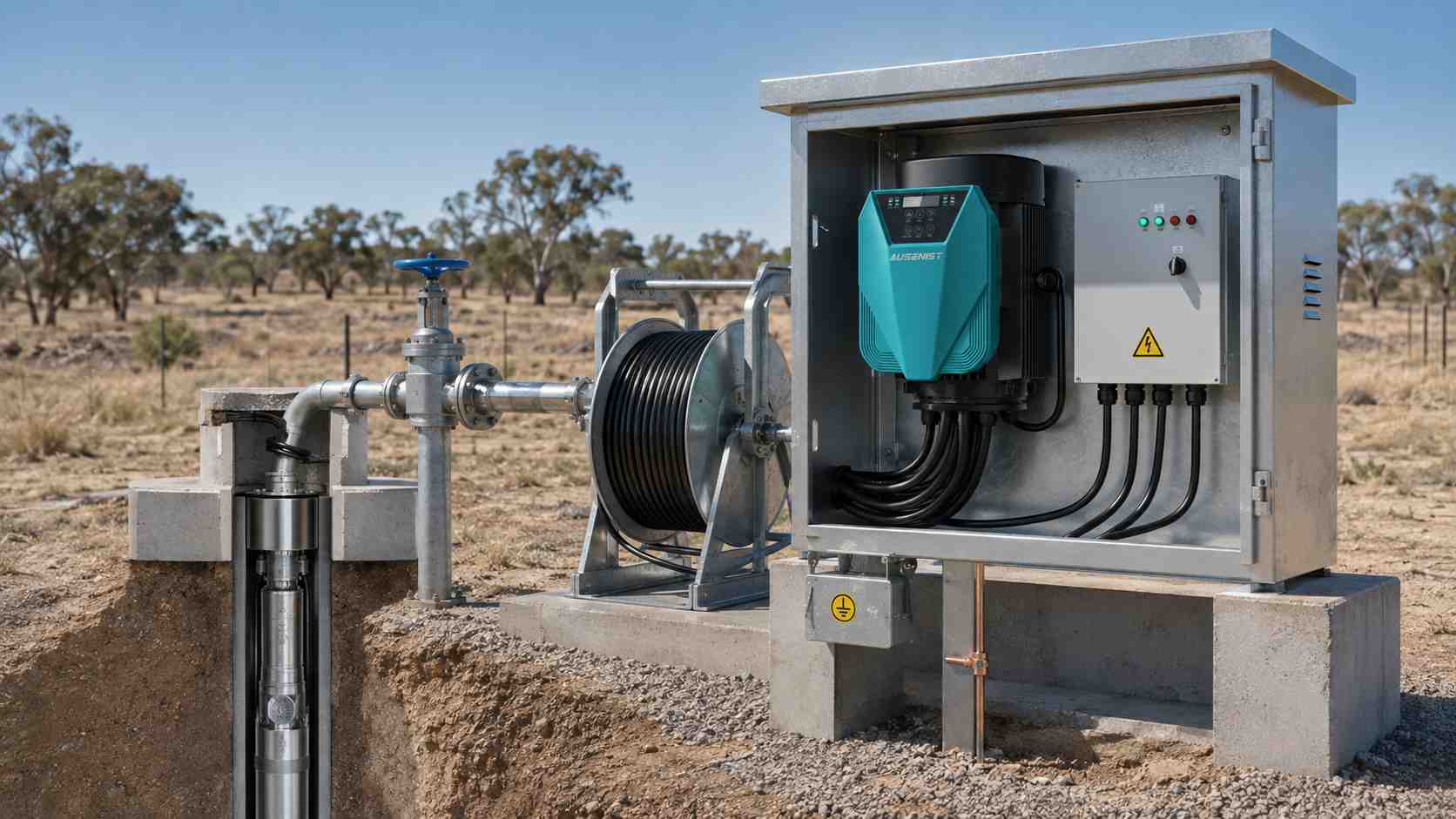
Engineering reference rendering; it is not a customer-site photograph.
For a 7.5kW deep-well pump with approximately 180m of total VFD-to-motor cable, reflected-wave voltage stress, leakage current and electromagnetic interference require an output-side review. The drive must be selected by motor current, while an output reactor or dv/dt filter, correct cable construction and continuous protective grounding are evaluated against the confirmed motor and VFD requirements.
Reference Design at a Glance
| Item | Reference Requirement |
|---|---|
| Reference market | South Africa |
| Pump | 7.5kW borehole submersible pump |
| Motor | 380V three-phase induction motor |
| VFD location | Surface wellhead control area |
| Motor cable | Approximately 180m total route in this example |
| Suggested series | AUSENIST YS620 or YS820, 380V class |
| Key accessories | Output reactor or dv/dt filter as engineering review requires |
What Information Is Required?
- Pump and motor nameplates, including rated current.
- Total VFD-to-motor cable length, not only well depth.
- Cable type, conductor size, shielding and grounding method.
- Motor insulation rating and any supplier cable-length limit.
- Borehole depth, static/dynamic water level and required flow.
- Generator or utility supply details.
- Pressure, level or flow control requirement.
Selection Example
For a 7.5kW, 380V pump with a 180m down-hole cable route, select the VFD so its continuous output current covers the motor current. Then confirm the motor insulation and cable construction. Because 180m is materially longer than a typical local motor connection, the output-filter decision should be documented rather than left at the default installation.
Do not publish a universal cable-length threshold: acceptable length changes with voltage, drive switching, cable construction, motor insulation and filter type.
Recommended Basic Configuration
| Setting | Initial Direction |
|---|---|
| Motor data | Enter exact nameplate values |
| Acceleration | Smooth ramp suitable for the water column |
| Deceleration | Avoid aggressive stopping that causes hydraulic shock |
| Minimum frequency | Set from pump and motor cooling requirements |
| Dry-run protection | Use level, pressure, current or combined evidence |
| Restart delay | Allow the source to recover before retrying |
| Switching frequency | Follow the approved long-cable configuration |
Why This Configuration?
An output reactor or dv/dt filter reduces voltage-rise stress reaching the motor. Correct grounding provides a controlled path for high-frequency current and reduces interference with pressure or level signals. Dry-run protection must be tuned to the actual borehole because a single generic current threshold may cause false trips or fail to detect a low-water condition.
Expected Result and Acceptance Checks
Expected behavior is smooth filling of the rising main, stable motor current and reliable stop/restart protection. Commissioning should record insulation checks, motor current, output-filter temperature, pressure or flow, dry-run response and signal stability. A qualified technician should perform all electrical tests.
Common Mistakes
- Treating well depth as the complete motor-cable length.
- Ignoring the motor manufacturer’s inverter and cable requirements.
- Installing the output filter at the motor instead of reviewing the correct location.
- Using an unshielded sensor cable beside motor conductors.
- Setting automatic restart without limiting attempts or recovery time.
AUSENIST Solution
AUSENIST can match the VFD to the submersible motor current, review the long-cable installation, recommend output-side protection and prepare dry-run and pressure-control parameters. Unknown motor insulation, damaged down-hole cable or inadequate grounding must be corrected before the VFD is commissioned.
FAQ
Does every deep-well pump need an output reactor?
No. The need depends on cable length, voltage, cable design, motor insulation and the selected VFD.
Can a pressure sensor protect against dry running?
It can contribute to the logic, but level or current information may provide better evidence depending on the system.
Can the VFD be installed outdoors at the wellhead?
Only with an enclosure and installation suitable for the actual weather, sunlight, dust, temperature and condensation conditions.
Send us the motor nameplate, total cable length, borehole depth, supply voltage and control requirement. We can recommend the VFD and long-cable protection configuration.