 Quanzhou Ausenist Technology Co., Ltd
 11kW Sewage Pump VFD Solution with Variable Level Control
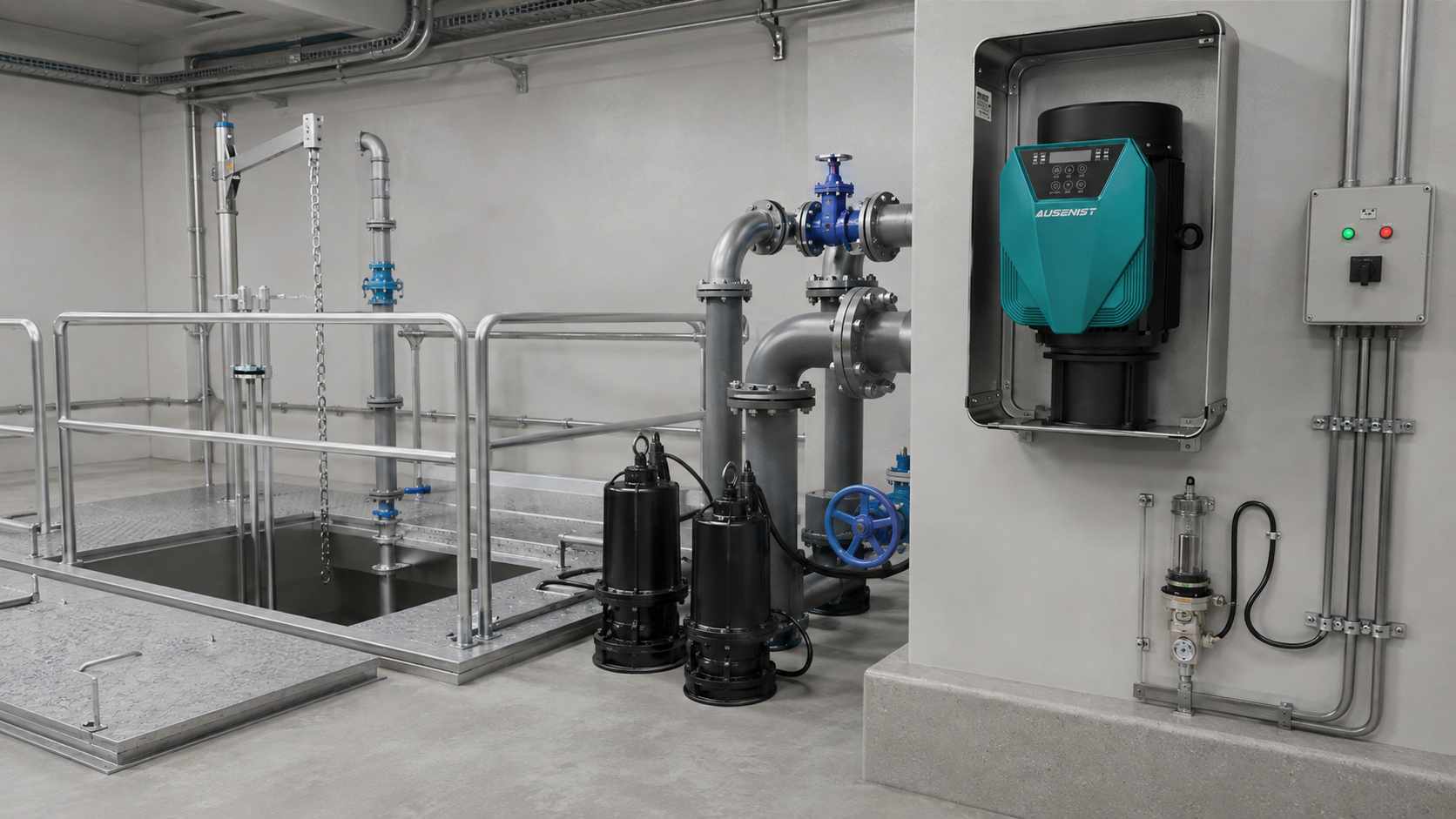
Engineering reference rendering; it is not a municipal customer-site photograph.
An 11kW sewage pump can use a VFD to control wet-well level, reduce abrupt starts and coordinate duty/standby operation. However, the pump must not run so slowly that solids settle or motor cooling becomes inadequate. The correct solution combines motor-current sizing, a usable minimum-speed limit, level feedback and independent high-level protection.
Reference Design at a Glance
| Item | Reference Requirement |
|---|---|
| Reference market | Indonesia |
| Pump | 11kW non-clog submersible sewage pump |
| Motor | 380V three-phase |
| Control target | Maintain wet-well level within an operating band |
| Feedback | Continuous level transmitter plus independent high-level float |
| Suggested series | AUSENIST YS620 or YS820, protected installation |
| Key constraint | Minimum self-cleaning flow and pump cooling |
What Information Is Required?
- Pump and motor nameplates and permitted speed range.
- Pump curve and minimum flow or velocity requirement.
- Wet-well dimensions and inflow profile.
- Static lift, discharge pipe size and check-valve arrangement.
- Level transmitter type/range and backup float logic.
- Number of pumps, duty/standby sequence and alarm requirements.
- Installation atmosphere, cabinet location and corrosion exposure.
Selection Example
For an 11kW, 380V sewage pump, select a VFD with continuous current capacity at least equal to the motor nameplate current after environmental review. Scale the level transmitter so the usable wet-well operating band maps correctly to the control range. Set the minimum frequency from the pump manufacturer’s permitted speed and the pipe’s self-cleaning requirement.
The independent high-level float should call the emergency sequence even if the analog level signal fails.
Recommended Control Logic
- Pump speed increases as wet-well level rises.
- A minimum run speed prevents extended low-velocity operation.
- The pump stops at the verified low-level point with an anti-cycling delay.
- A high-level float provides a separate alarm and emergency start request.
- In a duplex station, duty alternates and a healthy standby pump is called after a fault.
- Optional cleaning cycles must follow the pump manufacturer’s reverse or de-ragging limits.
Why This Configuration?
Continuous level control can smooth inflow handling, but wastewater is not the same as clean-water pressure control. Solids transport, ragging and wet-well geometry determine the safe low-speed limit. Independent high-level protection reduces reliance on one analog sensor.
Expected Result and Acceptance Checks
The expected result is controlled wet-well level, fewer abrupt starts and a clear backup response. Test transmitter loss, high-level float action, blocked-pump current, standby start, check-valve closure and the lowest permitted operating speed. Record results rather than assuming protection works from default values.
Common Mistakes
- Using clean-water PID settings without reviewing the wet-well process.
- Setting frequency too low for solids transport.
- Relying on one level transmitter for both control and emergency protection.
- Enabling reverse operation without pump approval.
- Installing electronics in a corrosive or classified area without suitable protection.
AUSENIST Solution
AUSENIST can match YS620 or YS820 to motor current, prepare level-scaling and duplex sequencing parameters and support customized I/O logic. Hazardous-area requirements, statutory controls and pump-specific de-ragging functions require separate engineering approval.
FAQ
Is constant pressure control suitable for sewage lift stations?
Usually level control is more relevant. The correct control variable depends on the hydraulic process.
Can a sewage pump run continuously at very low speed?
Not automatically. Minimum speed must protect motor cooling and maintain adequate solids transport.
Is a backup float still needed with an analog level sensor?
It is strongly recommended for an independent high-level alarm or emergency sequence.
Send us the motor nameplate, wet-well dimensions, inflow range, pump curve and duty/standby sequence. We can prepare a sewage-pump VFD selection and control proposal.